THREE PILLARS FOR VIETNAM TO EMERGE AS A LEADING MARITIME POWER
Vietnam has significant advantages in its strategic location, long coastline, and deep-water port system. But natural advantages alone are not enough to become a strong maritime nation. Three key pillars are essential: Green Ports – Digital Ports – Leading Enterprises. Green ports support sustainable growth.Digital ports improve efficiency through data and technology.Strong enterprises connect Vietnam more deeply to global logistics and supply chains. The goal is not simply to build more ports, but to strengthen management capabilities, technology, and control over the value chain. Vietnam already has the advantages of the sea.The next step is turning those advantages into national competitiveness.
On July 28, 2026, General Secretary and President To Lam signed and promulgated Resolution No. 20-NQ/TW of the third Conference of the 14th Party Central Committee on building and developing Vietnam into a strong maritime nation. One of the goals by 2030 is to build a solid foundation for Vietnam to become a strong maritime nation. With a vision toward 2045, Vietnam will be a strong maritime nation, prosperous from the sea, sustainably developed from the sea, with modern governance, advanced science and technology...
In an interview with Tri Thuc - Znews, Pham Anh Tuan, General Director of Portcoast Consultant Corporation, said that for Vietnam to move from being a country with many seaports to a strong maritime nation, with deeper control over maritime value chains and international logistics, there must be coordinated integration of three pillars: green ports, digital ports, and leading corporations and enterprises.

Mr. Pham Anh Tuan, General Director of Portcoast Consultant Corporation. Photo: Courtesy of the interviewee.
How can enterprises lead the way toward a nation prosperous from the sea?
- Resolution 20-NQ/TW clearly calls for a strong shift in thinking from marine exploitation to modern marine governance; from developing the marine economy to developing a strong maritime nation... In your opinion, what tools are needed to drive this shift in thinking?
- First, it should be clearly stated that Resolution 20-NQ/TW marks an important shift in marine development thinking: from resource exploitation to modern marine governance; from developing individual sectors separately to developing a strong maritime nation based on science, technology, digital data, and integrated governance. The Resolution also identifies green transformation, digital transformation, and the development of leading maritime enterprises, especially large corporations and general corporations, as important driving forces.
Vietnam has abundant marine resources. Where there is oil and gas, oil and gas are exploited; where a port can be built, port resources are developed; where wind power can be developed, wind power is developed; and where fisheries can be harvested, we fish. That is "exploitation", and it is also the approach that has existed for a long time.
Marine governance, on the other hand, is the coordination among the different spaces of the marine economy. Today, we must not only exploit the sea, but also "nurture the sea" so that it can continue developing sustainably.
To change this mindset, we must first build awareness of the issue; then begin developing regulations and institutions for marine economic development, while establishing a reasonable and optimized marine spatial plan.
It can be seen that marine resource planning has traditionally been carried out according to the functions and responsibilities of each ministry and sector. For example, the Ministry of Agriculture and Environment is responsible for fisheries; the Ministry of Industry and Trade is responsible for energy and oil and gas; and the Ministry of Construction (formerly the Ministry of Transport) is responsible for seaports and maritime transport... Although ministries and sectors are consulted during the planning process, that alone is not enough.
A few years ago, Vietnam developed a marine spatial plan. However, this plan was not prepared with sufficient depth and did not thoroughly analyze and integrate economic sectors; overlaps still exist between fisheries exploitation and protection of aquatic resources on one hand and energy development on the other, or between energy development, particularly offshore wind power, and maritime transport.
Vietnam now needs a unified marine spatial plan. This requires coordination and joint efforts among economic sectors as well as local authorities.
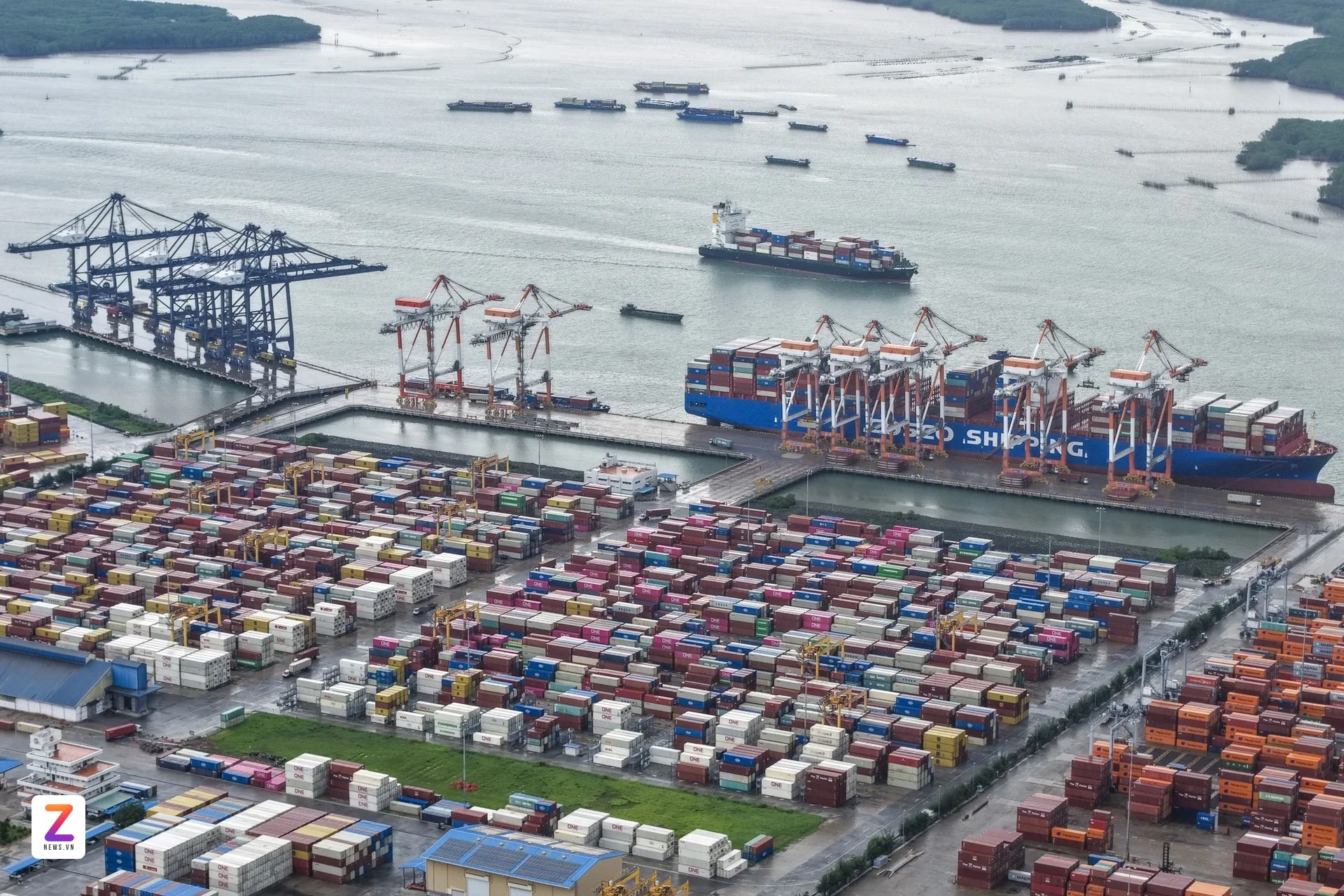
The Cai Mep - Thi Vai port cluster is Vietnam's largest deep-water seaport cluster and plays an important role in the global supply chain. Photo: Quynh Danh.
- A notable point is that Resolution 20-NQ/TW assigns maritime enterprises a leading role. In the current context, how should the State and enterprises divide responsibilities and work together?
- Resolution 20-NQ/TW calls for strong development of maritime enterprises that play a leading role; the formation of large-scale state-owned and private corporations with international competitiveness; and stronger links between domestic enterprises and multinational corporations so they can participate more deeply in the global ocean value chain.
I believe this direction is appropriate for the characteristics of the maritime industry. Developing gateway ports, transshipment ports, shipping fleets, logistics, energy, and digital platforms all requires substantial investment capital, advanced technology, management capability, and international market networks.
Therefore, to realize this goal, there must be a clear division of roles and effective cooperation between the State and enterprises. The State should make catalytic investments and provide seed capital, create enabling corridors, and develop shared infrastructure such as maritime channels, maritime navigation aids, vessel management and monitoring systems, and transport infrastructure connecting the hinterland to ports... Meanwhile, investment in ports and port-handling equipment should be undertaken by enterprises and corporations.
The experience of Cai Mep - Thi Vai shows that an effective model is "The State creates the framework - enterprises invest". The State carries out long-term planning and invests in maritime channels, transport connections, and shared public infrastructure, while domestic enterprises, FDI investors, shipping lines, and international port operators invest in terminals, equipment, technology, and cargo organization. This combination has created a modern deep-water port cluster directly connected to the global maritime transport network.
However, a leading role should not be evaluated solely by the scale of capital. For gateway port and international transshipment projects, investors must also have port operation experience, shipping line and logistics networks, the ability to commit cargo volumes, technological capability, green and digital governance capacity, and plans to develop domestic supply chains.
Leading corporations should create spillover effects through links with small and medium-sized enterprises, research institutions, universities, and technology companies, gradually helping Vietnamese enterprises gain control over data, technology, and high-value-added maritime services.
Green ports are the development goal, digital ports are the foundation and governance method, while corporations and enterprises are the forces that organize implementation and lead the market.
General Director Pham Anh Tuan
Another important point is that among the nine tasks the Government has asked ministries, ministerial-level agencies, and People's Committees of centrally governed provinces and cities to proactively plan and implement decisively and consistently, three groups of tasks are especially important to the maritime sector: developing maritime enterprises; developing science, technology, innovation, digital transformation, and high-quality human resources; and creating breakthroughs in the development of modern, green, smart marine economic sectors and new marine industries.
In my view, these three areas should be considered as a unified whole: green ports are the development goal, digital ports are the foundation and governance method, while corporations and enterprises are the forces that organize implementation and lead the market.
Green ports define the destination, while digital ports provide data and governance tools
- Resolution 20 also sets the goal of completing the seaport system in a green, smart, and modern direction. In your opinion, what needs to change in planning, investment, and port operations to complete the green port system?
- Green port development should not be understood simply as replacing some diesel equipment with electric equipment or adding more trees within port areas. It must be a comprehensive transformation throughout the entire seaport lifecycle, from planning, design, and construction to operation, maintenance, and hinterland logistics connectivity.
The concept of a green port includes efficient use of resources and energy; reduction of greenhouse gas emissions; control of wastewater, waste, noise, and environmental incidents; protection of marine ecosystems; development of clean energy, shore power, and low-emission transport; and improved resilience to climate change.
For newly built ports, the principle of "green from the design stage" should be applied. This means optimizing spatial planning, materials, dredging, flows, and sedimentation and erosion; while integrating shore power infrastructure, charging stations, renewable energy, and electric cargo-handling equipment. For existing ports, transformation should follow the asset lifecycle and equipment depreciation periods.
Decision No. 876/QD-TTg established a roadmap under which, from 2031, newly invested or additionally invested ports must use electric vehicles and equipment, green energy, or equivalent solutions; from 2040, equipment at existing ports must be converted; and by 2050, all port vehicles, equipment, and maritime navigation aids must meet these requirements.
"Green" must be measured through substantive results in line with three groups of criteria: commitment and readiness; action and implementation; and effectiveness and efficiency. Therefore, each port needs an emissions inventory, phased emission-reduction targets, an energy management system, and performance indicators per unit of cargo throughput.
It should be emphasized that green ports cannot be separated from digital ports, because without data, it is difficult to demonstrate emission reductions and the efficiency of resource use.
- If green ports cannot be separated from digital ports, what role do digital ports play in the port greening process?
- A digital port is not simply about digitizing procedures or deploying several standalone software applications. The digital port concept should be organized around two components.
The first is the digital infrastructure of port assets, including BIM-GIS models, Digital Twins, survey data, maritime channels, underground structures, equipment, and IoT sensor systems.
The second is the operational flow management system, in which each enterprise's Terminal Operating System (TOS) must be interconnected with the Port Community System (PCS), connecting port enterprises, shipping lines, logistics providers, and state management agencies.
If BIM is the data foundation for the infrastructure lifecycle, then the Digital Twin is the operational environment that continuously updates real-world data for simulation, forecasting, and decision support. On this foundation, ports can simulate cargo-handling scenarios, coordinate vessel arrivals at the right time, optimize yards and port gates, predict equipment maintenance, manage electricity consumption and emissions, monitor the environment, and prepare incident-response scenarios in advance.
Thus, digital ports not only increase productivity but also directly enable the achievement of green port objectives.
The competitiveness of future seaports will increasingly depend on processing speed, transparency, forecasting capability, and the reliability of the entire supply chain.
Portcoast General Director Pham Anh Tuan
One representative project is Gemalink Port in Cai Mep. The port has been recognized as meeting the green port standards of the Vietnam Maritime Administration and is an important link in the global green transport corridor. It is also a regular destination for mega container vessels powered by clean energy.
Gemalink Port's infrastructure has also been digitized by Portcoast using BIM and is moving toward a Digital Twin. The port simultaneously applies digitalization to both infrastructure and operations through two applications, SmartPort and SmartGate.
SmartPort allows customers to carry out cargo receipt and delivery, lifting and lowering, container stuffing and stripping, and other port services quickly and accurately, taking about 10 minutes for a set of orders instead of 3-4 hours as before.
SmartGate uses AI to automatically identify information such as container numbers, vehicle license plates, trailer license plates, seal numbers, driver's licenses, citizen identification cards, and load inspection certificates... and compares them with previously declared data. The entire verification and gate barrier opening/closing process takes place automatically within only 5-7 seconds, while maintaining a high level of automatic recognition accuracy.
The application also connects relevant parties throughout the logistics supply chain, thereby optimizing container transport operations and reducing waste and costs.
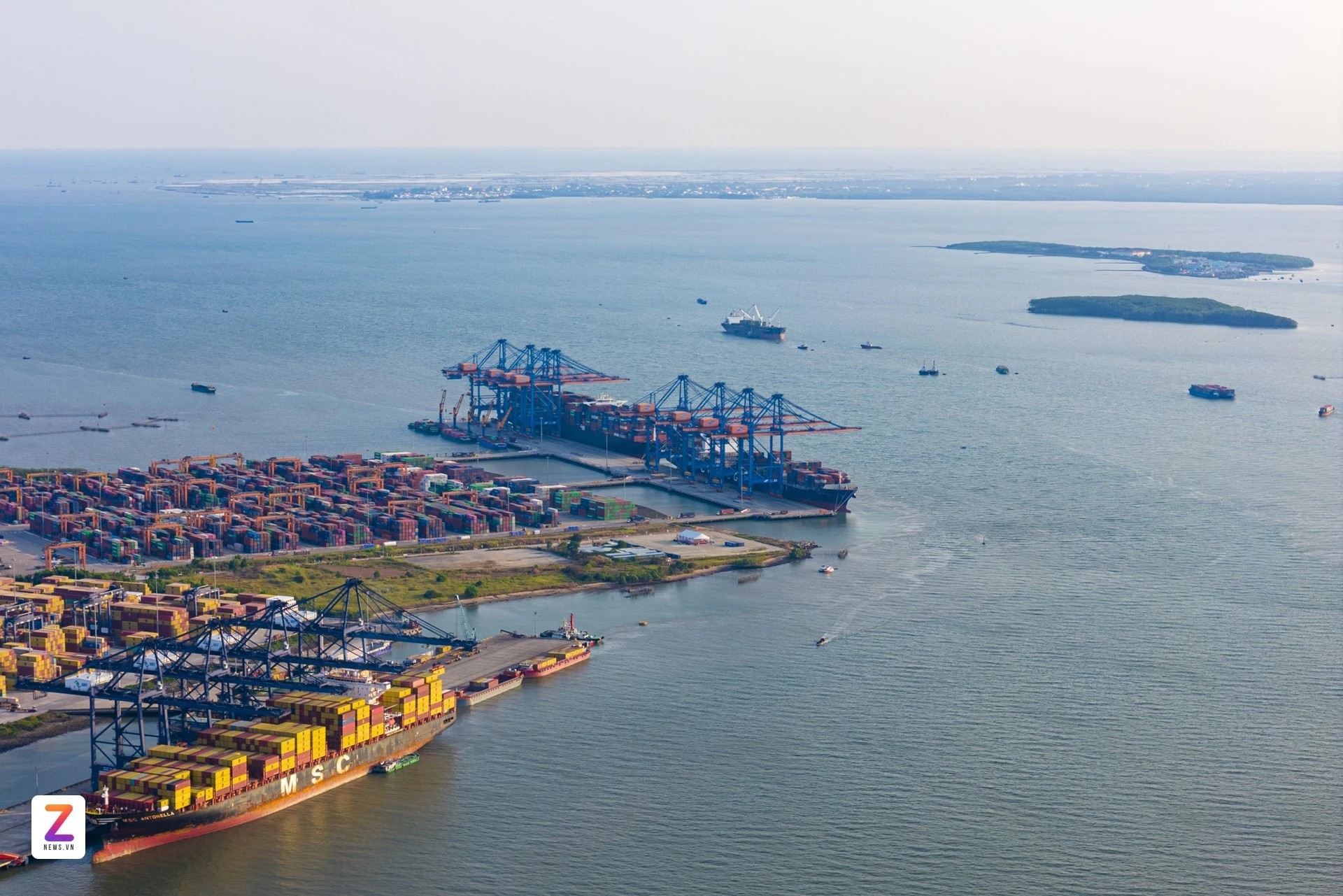
Resolution 20-NQ/TW sets a vision toward 2045 in which Vietnam becomes a strong maritime nation, prosperous from the sea, and sustainably developed from the sea. Photo: Quynh Danh.
Returning to the broader issue, the long-term direction must be to establish a national digital seaport system with a unified data architecture, connectivity standards, and PCS platform, rather than allowing each port to invest separately without interconnection. The competitiveness of future seaports will be determined not only by berth length or the number of pieces of equipment, but increasingly by processing speed, transparency, forecasting capability, and the reliability of the entire supply chain.
I want to emphasize that green ports define the destination, digital ports provide data and governance tools, and corporations and enterprises mobilize capital, technology, human resources, and market networks to turn policy directions into real competitive capacity.
- Thank you for sharing your insights!
Portcoast has participated as a consultant in many key national projects, such as the Master Plan for Vietnam's Seaport System for the 2010-2020 period with orientation to 2030; the Ho Chi Minh City - Dong Nai - Ba Ria - Vung Tau Port System Plan; comprehensive studies of maritime channels, terminals, and ports at Cai Mep - Thi Vai; and the Cai Mep Ha Logistics Center... The company places strong emphasis on digital transformation and the application of BIM-GIS models and Digital Twins in surveying, design, construction, and management of seaport infrastructure.
Tri Thuc - Znews introduces readers to the Economic Knowledge Bookshelf, featuring a diverse range of books and stories in business and economics. It serves as a source of reference for those interested in and seeking to improve their knowledge of economics. The books and stories in the Bookshelf are not merely works of knowledge, but also contain valuable insights and experience from reputable authors and managers with many years of industry experience.
Reading not only helps readers access new knowledge but also broadens their perspectives and supports personal development. The Economic Knowledge Bookshelf aims to spread knowledge in the field of business while also promoting a reading culture among Vietnamese people.
Source: znews.vn
Pageviews: 0
PORTCOAST AND DIGITAL TWINS FOR VIETNAM’S PORT INFRASTRUCTURE
By autonomyglobal.co - 18/08/2026
Autonomy Global recently featured how Portcoast is combining Reality C...
Portcoast and Thuyloi University Introduce Digital Twin and AI Agent Solutions for Higher Education
By tlu.edu.vn - 07/08/2026
On the afternoon of August 6, at T35 Hall, Thuyloi University, in coll...
PORTCOAST: DIGITAL TECHNOLOGY OPENS NEW BREAKTHROUGH OPPORTUNITIES FOR THE CONSTRUCTION INDUSTRY
By bnews.vn - 04/08/2026
In the implementation of Resolution No. 57-NQ/TW, Mr. Tran Phuc Minh Q...