Portcoast Pioneers BIM–GIS Solutions in Transportation and Infrastructure Development in Ho Chi Minh City
This morning, the Ho Chi Minh City Department of Construction organized a conference on the strategy for implementing BIM–GIS in transportation and infrastructure development. The event brought together government authorities, experts, and enterprises to seek comprehensive digitalization solutions for the construction industry. In its presentation, Portcoast – Vietnam’s leading consultancy in infrastructure digital transformation – introduced a series of breakthrough technologies: Scan to BIM, BIM, Digital Twin, and smart city models integrated with BIM–GIS. These solutions not only ensure transparency of information and accurate data management but also create favorable conditions for improving the efficiency of infrastructure operation. Portcoast’s presentation was highly appreciated for its practicality and immediate applicability to major projects in the city, reaffirming the company’s pioneering position in driving the digital transformation of Vietnam’s infrastructure sector.
At the event, Portcoast - the leading consulting unit in Vietnam in digital transformation in transportation and infrastructure - introduced advanced digitalization solutions such as BIM-GIS, Scan to BIM technology, Digital Twin and smart city. These technologies not only optimize the construction process but also improve infrastructure management efficiency.
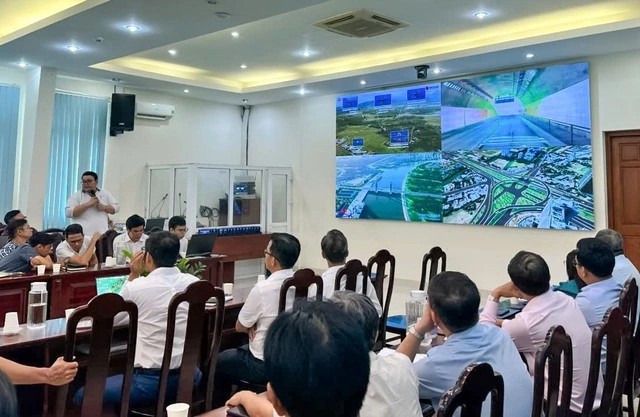
Portcoast presentation attracted special attention from delegates and was considered one of the highlights of the conference
PHOTO: PORTCOAST
These technologies brought many surprises, showing great potential in improving project management efficiency, optimizing operations, and promoting a comprehensive digitalization strategy in the construction - infrastructure field.
The highlight of the BIM-GIS model (building information model - geographic information) is its ability to connect data and visualize in three dimensions. Engineers and managers can easily access, analyze, and evaluate the current status of the citys technical infrastructure assets right on the digital platform. This not only shortens inspection and monitoring time but also helps make more accurate decisions in maintenance and repair processes, thereby extending the lifespan of works and minimizing waste.
In addition to technical benefits, BIM-GIS also carries strategic significance in urban infrastructure management. When infrastructure data is digitized, integrated, and synchronized, city authorities can use it for planning, transportation development, and modern urban management. This is an important foundation for building a smart city, where data becomes a "digital asset" supporting effective governance.
According to Portcoast representative, in the digital transformation era, the application of digital technology in infrastructure and transportation is not only an inevitable trend but also brings practical values. Clear evidence comes from the Pennsylvania Department of Transportation (USA), showing that when underground infrastructure was precisely digitized in highway projects, the return on investment (ROI) increased dramatically. Specifically, for every 1 USD spent on digitalization, the system could save up to 21 USD. This is an impressive figure, directly reflecting the huge benefits of investing in technology for infrastructure.
The Portcoast representative also cited analysis from the Royal Academy of Engineering, UK, providing convincing evidence that initial capital investment in works usually accounts for only about 20 - 33% of the total life cycle cost of a project. Most costs lie in operation and maintenance stages. The UK government considers BIM as a method that can save 20% in the procurement and operation of publicly funded assets.
This benefit comes from the fact that digitized data improves accuracy in surveying, design, and construction; while minimizing risks arising during implementation. Accurate information systems also effectively support operation and maintenance stages, which account for a large proportion in the life cycle of transport - infrastructure projects. That explains why many developed countries see digitalization as an important tool to save costs and improve public asset management efficiency.
In Vietnam, Ho Chi Minh City is gradually following this trend. One of the typical projects is the application of BIM-GIS in managing Metro Line 1 (Ben Thanh - Suoi Tien). The asset management system is built based on an identification code for each equipment and infrastructure item. As a result, all operational information, maintenance history, and equipment status are stored, updated, and managed synchronously.
Both international and domestic practices affirm that investing in digitalizing infrastructure is a long-term profitable investment. For Ho Chi Minh City, the application of BIM-GIS for Metro Line 1 is not only the starting step for large-scale infrastructure asset management but also opens up prospects for expanding this model to many other works. At that time, synchronized management from planning, construction to operation will become reality, contributing to cost savings, enhancing transparency, and moving towards a modern and sustainable city.
Source: thanhnien.vn
Pageviews: 0
CC1 AND PORTCOAST SIGN STRATEGIC MEMORANDUM OF UNDERSTANDING ON DIGITAL TRANSFORMATION IN CONSTRUCTION
By cc1.vn - 16/09/2025
On September 16, 2025, at the 12th-floor Auditorium of the headquarter...
PORTCOAST HONORED FOR THE SECOND CONSECUTIVE YEAR WITH THE SPECIAL ACHIEVEMENT IN GIS – SAG AWARD 2025
By thanhnien.vn - 31/07/2025
Portcoast is honored to receive the Special Achievement in GIS (SAG Aw...
Seminar "GIS and BIM Application - opportunities and challenges?"
By baoxaydung.vn - 27/06/2025
On the afternoon of June 27th, the Construction Newspaper organized a ...