Portcoast Accelerates BIM-GIS Adoption for Infrastructure Management and Maintenance
Mr. Phạm Anh Tuấn, General Director of Portcoast, stated: The BIM-GIS model will help shorten the time required for inspection and supervision, enable more accurate decision-making during maintenance and repair processes, extend the lifespan of structures, and minimize waste.
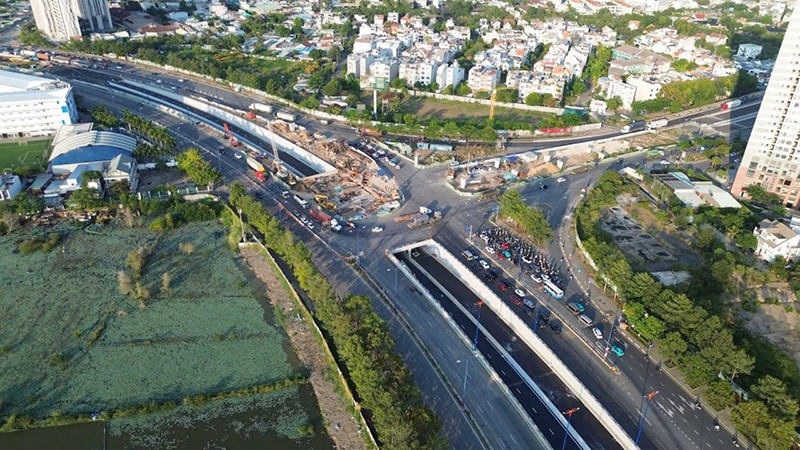
An Phu traffic intersection - one of the key technical infrastructure projects of Ho Chi Minh City. (Photo: Contributor)
This is one of the recent directives from Vice Chairman of the Ho Chi Minh City People's Committee, Bui Xuan Cuong. Accordingly, relevant units need to strengthen the application of AI in several ongoing construction projects to improve management efficiency, monitor progress and quality, and enhance supervision of key transportation projects.
Besides the An Phu and Tan Van intersections, the City Digital Transformation Center has been assigned to coordinate with the City Department of Construction, project management boards, and contractors to integrate and analyze data from multiple sources such as cameras, transportation systems, and BIM-GIS data (Building Information Modeling – Geographic Information System); serving the assessment of progress, construction quality, labor safety supervision, and early detection and warning of traffic congestion.
In particular, project management boards and contractors are required to cooperate closely to share and provide complete data to the City Digital Transformation Center; including camera images, BIM-GIS data, detailed daily construction schedules, etc.; and to strictly comply with regulations on BIM application in construction project management.
The City People's Committee has assigned the Department of Construction to coordinate with the Digital Transformation Center to report pilot implementation results in November; at the same time, to propose the development of a comprehensive project management software to be applied to all key projects by 2030.
Currently, the city is simultaneously implementing many key transportation infrastructure projects such as Ring Road 2, Ring Road 3; An Phu and My Thuy intersections; Ho Chi Minh City–Moc Bai Expressway; and western gateway transportation projects…
Additionally, the city has planned to prepare investment for about 154 transportation infrastructure projects (including 29 category A projects) for the 2026–2030 period, with many key projects such as: Ring Road 4, Binh Tien Bridge and Road, and four BOT gateway projects (expansion of National Highways 1, 13, 22, and the North–South axis road)...
In this context, in previous years, the city’s construction and transportation sectors have actively sought and applied advanced and modern technologies to optimize construction and operation processes, enhance management efficiency of technical infrastructure works, and promote comprehensive digital transformation strategies in construction and infrastructure sectors.
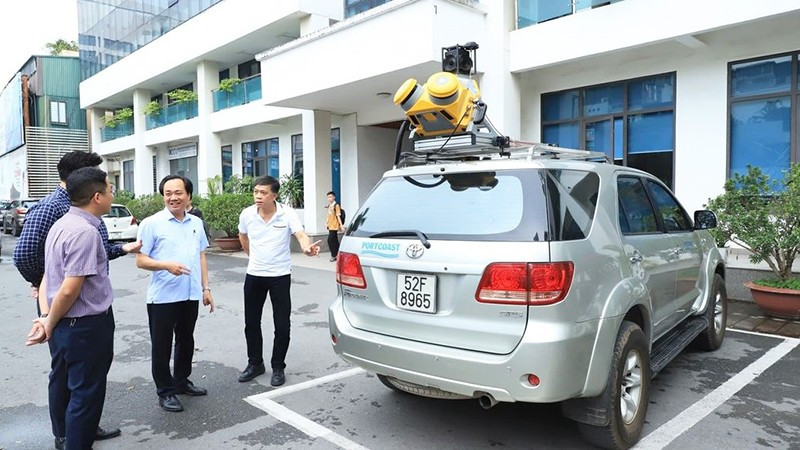
A representative from Portcoast Consultant Corporation introduces a digital technology device and AI application used for infrastructure digitization. (Photo: Contributor)
In July 2024, the Ho Chi Minh City Urban Railway Company No.1 (HURC1) signed a cooperation agreement with Portcoast Consultant Corporation to implement BIM-GIS and 3D modeling in the maintenance and operation of Metro Line 1 (Ben Thanh–Suoi Tien). This initiative helps HURC1 develop appropriate maintenance and servicing plans to optimize the operation of equipment and related costs.
Portcoast’s General Director, Pham Anh Tuan, stated: The BIM-GIS model will help shorten inspection and supervision time, enable more accurate decision-making during maintenance and repair, extend the lifespan of structures, and minimize waste.
According to analysis by the Royal Academy of Engineering (UK), BIM helps save up to 20% of costs in construction procurement and operation. Meanwhile, research from the Pennsylvania Department of Transportation (USA) shows that accurate digitization of underground infrastructure in highway projects saves significant costs throughout the lifecycle of the infrastructure (construction, operation, maintenance, and repair). For every 1 USD spent on digitization, 21 USD can be saved.
Experts emphasize that applying AI in managing and supervising progress and quality of infrastructure construction projects is a strategic and essential step to modernize management and operation processes, enhance transparency, reduce risks, improve construction efficiency, and ensure projects are completed on time and meet quality standards. This will be a crucial foundation for the city to achieve its goal of becoming a modern, smart, and safe urban area with sustainable infrastructure development in the 2025–2030 period and beyond.
Source: nhandan.vn
Pageviews: 0
Pioneering Digital Transformation in Vietnam’s Infrastructure Industry
By thanhnien.vn - 13/10/2025
With a deep investment strategy in technology and strong execution cap...
Mr. Pham Anh Tuan (Portcoast): Ho Chi Minh City Needs Breakthrough Policies to Develop a Maritime–Financial Ecosystem
By baoxaydung.vn - 09/10/2025
Mr. Phạm Anh Tuấn stated that international maritime centers are alway...
PORTCOAST AT THE HO CHI MINH CITY INDUSTRY AND TRADE DEVELOPMENT FORUM 2025
By tuoitre.vn - 23/09/2025
On September 23, at the closing conference of the Ho Chi Minh City Ind...