Port Relocation – A Strategic Step for Ho Chi Minh City
Relocating ports away from the city center will not only help ease traffic congestion but also create opportunities to restructure the urban landscape, develop riverfront areas, and improve residents’ quality of life. According to Mr. Pham Anh Tuan, General Director of Portcoast, the Cai Mep – Thi Vai – Can Gio area should be developed into a major gateway port cluster, while inland waterway connectivity should be strengthened to reduce dependence on road transport. Former port sites should be prioritized for parks, public spaces, commercial and service facilities, and riverfront tourism. As most port operators are private-sector businesses, the relocation roadmap and timeline should be carefully planned to avoid disrupting their production and business operations. The city should also prioritize creating favorable conditions for affected businesses to invest in and develop new port facilities.
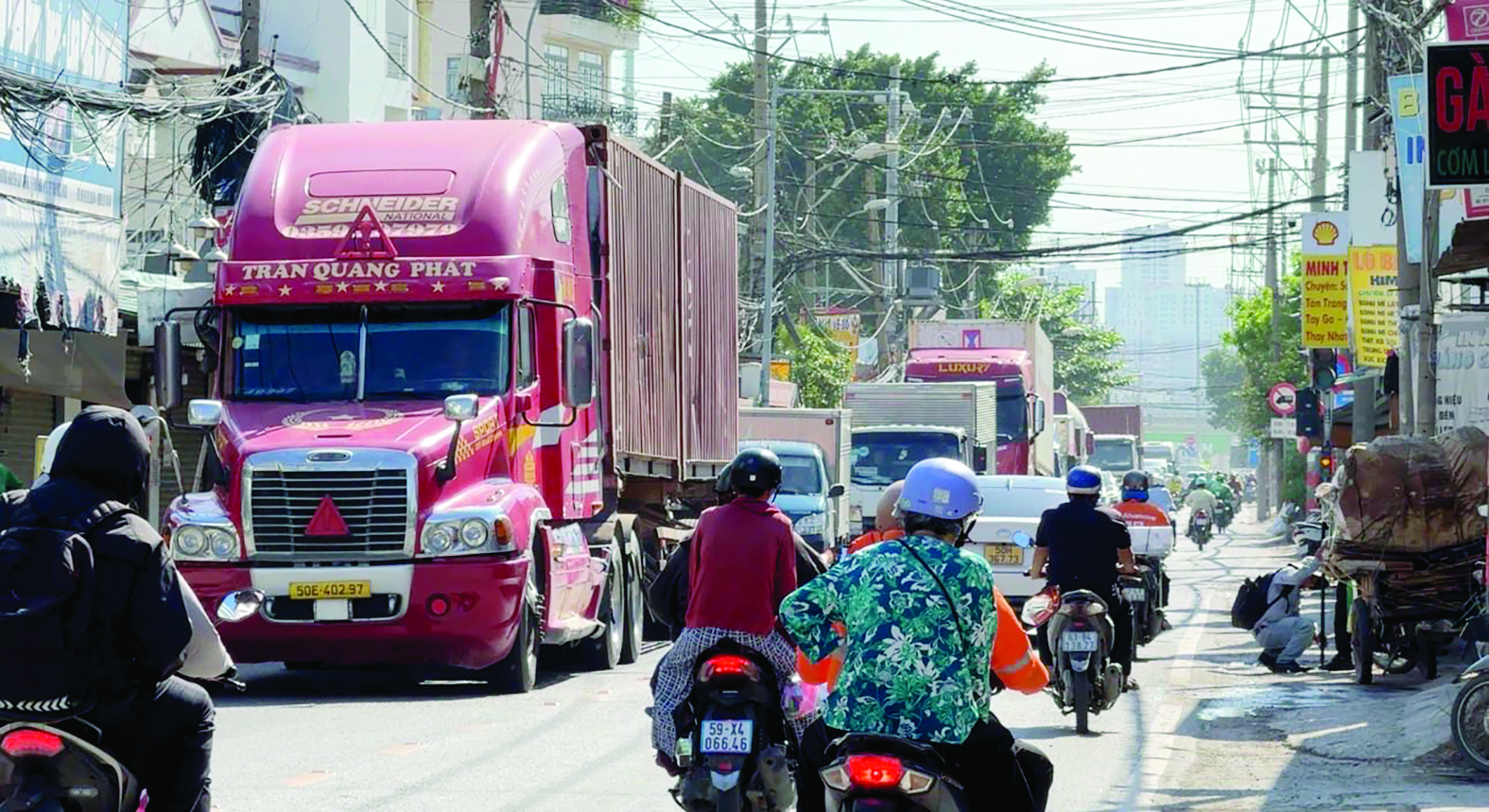
A large number of container trucks travel along Nguyen Duy Trinh Street toward Tan Cang - Cat Lai Port in Ho Chi Minh City. Photo: DINH DU
Residents Hope for Early Port Relocation
Residents living along Nguyen Duy Trinh Street in Phu Huu, Long Truong and Truong Thanh wards witness thousands of container trucks and tractor-trailers traveling to and from the Cat Lai and Phu Huu port clusters every day. Many sections of the road are frequently congested, posing potential risks of traffic accidents. The area around Gate G of Tan Cang - Cat Lai Port has deteriorated, generating clouds of dust as vehicles continuously enter and exit, affecting the daily lives of residents living along the route. Therefore, the policy of relocating seaports away from the city center has received widespread support from the majority of residents, particularly those living along the affected roads who regularly face pressure from heavy port-related traffic.
Mr. Tran Van Cuong, a resident living on Nguyen Duy Trinh Street in Long Truong Ward, said that local residents would strongly support the relocation of ports away from the city center. For many years, residents have had to live with pollution and dust while constantly worrying about the risk of traffic accidents.
A representative of the Ho Chi Minh City Department of Construction stated that the policy of relocating several seaports away from the central area had been proposed by the city many years ago. However, no specific implementation plan has been introduced to date. The department is currently developing plans and solutions and collecting feedback from relevant departments and agencies to finalize the plan before submitting it to the Ho Chi Minh City People’s Committee for consideration and further implementation.
Mr. Pham Anh Tuan, General Director of Portcoast Consultant Corporation, stated that Ho Chi Minh City’s current policy represents an inevitable trend. However, given the expanded urban space of Ho Chi Minh City, the city must clearly identify its primary hub and gateway port area, which will be the Cai Mep - Thi Vai - Can Gio area.
The relocation of ports from the central area may be carried out by discontinuing port operations within the inner city and concentrating operations at the Cai Mep - Can Gio ports. Another approach would be to transfer the role of the main port hub from central ports to Cai Mep - Can Gio. Under this model, central ports would serve as domestic transshipment points. Inland waterways would become the primary mode of connection between these transshipment points and the gateway port system. Furthermore, to prevent the emergence of new bottlenecks, the city should develop a transportation network in which inland waterways serve as the backbone, while inland waterway ports and terminals function as logistics hubs for consolidating and distributing goods throughout the network.
Prioritizing the Development of Public Spaces
Relocating inner-city port terminals toward river mouths and coastal areas is an inevitable process that has occurred in many countries, such as the United States, where port activities shifted from Manhattan to New Jersey; Germany, from Bremen to Bremerhaven; and Thailand, from Bangkok to Laem Chabang. The relocation is required not only to support urban development but also to respond to the evolving development trends of the maritime industry. Once the relocation process is completed, both the urban landscape and the seaport system will be significantly improved.
According to Mr. Pham Anh Tuan, after the ports along the Saigon River are relocated, the available land should be prioritized for the development of public spaces and commercial and service facilities. Boulevards and parks associated with maritime museums and commercial and service areas could be developed along the Saigon River, contributing to tourism, the riverside economy and the nighttime economy. As most port operators are private enterprises, the relocation schedule and timeframe should be carefully planned to avoid disrupting their production and business activities. The city should prioritize creating favorable conditions for affected enterprises to invest in and construct new ports.
Meanwhile, Associate Professor Dr. Nguyen Ngoc Vinh, Deputy Director of the Institute for Regional Research and Development Consulting at the University of Economics Ho Chi Minh City, stated that this is considered a strategic step in restructuring Ho Chi Minh City’s economic space and promoting sustainable urban development. The policy would not only reduce pressure on inner-city traffic by removing thousands of container trucks and heavy-duty vehicles from major roads every day, but would also improve residents’ living environment by reducing noise, fine dust and exhaust emissions. The complete relocation of seaports away from central Ho Chi Minh City would help establish a continuous chain of architectural landscapes and services, while creating additional space for public areas, parks, transportation infrastructure and high-value commercial and service facilities.
Under Decision No. 407/QD-BXD issued by the Ministry of Construction, approving the Detailed Planning for the Development of Land and Water Areas of Ho Chi Minh City Seaport for the 2021–2030 Period, with a Vision to 2050, Ho Chi Minh City Seaport comprises the following terminal areas: Cat Lai - Phu Huu, Saigon River, Hiep Phuoc, Nha Be and Long Binh; the Can Gio International Transshipment Port terminal area; potential port terminals in Can Gio; floating terminals; and anchorage areas for waiting, navigation avoidance and storm shelter.
Regarding infrastructure development, with a vision to 2050, Ho Chi Minh City will continue investing in the Can Gio International Transshipment Port terminal area. Together with the port terminals in the Cai Mep - Thi Vai area, it will form a large-scale international transshipment port cluster of regional and international significance in Asia. The city will also complete the relocation of port terminals along the Saigon River in accordance with the development of Ho Chi Minh City’s urban space.
Source: sggp.org.vn
Pageviews: 0
Portcoast triển khai thành công Digital Twin tại Cái Mép - Thị Vải: Bước tiến mới cho cảng biển số Việt Nam
Theo dttc.sggp.org.vn - 16/07/2026
Ông Phạm Anh Tuấn, Tổng Giám đốc Portcoast, nhận định, xây dựng cảng b...
Liên danh Công ty TNHH Viện Nghiên cứu Thiết kế tàu điện ngầm Quảng Châu - TediSouth - Portcoast trúng gói thầu tư vấn Metro số 6
Theo tuoitre.vn - 04/07/2026
Metro số 6 TP.HCM tiếp tục có bước tiến mới, với việc Ban Quản lý đườn...
TẠP CHÍ ĐIỆN TỬ CỦA BỘ XÂY DỰNG: BIM, GIS HAY DIGITAL TWINS CHỈ PHÁT HUY GIÁ TRỊ KHI NỀN DỮ LIỆU HIỆN TRẠNG ĐỦ TIN CẬY
Theo tapchixaydung.vn - 28/06/2026
Với các dự án đường sắt đô thị, công nghệ không phải là gốc rễ của rủi...