PORTCOAST INVESTS IN ASIA’S MOST ADVANCED 3D SURVEYING AND DIGITAL TWIN TECHNOLOGIES
In an article reporting the views of Assoc. Prof. Dr. Hoang Tung, Rector of Hanoi University of Civil Engineering, Doanh Nghiep Viet Nam magazine highlights: “In the digital transformation of construction, Portcoast invests in Asia’s most advanced 3D surveying equipment and digital twin models.”
The gap between research and the ability to master technology
At a seminar on commissioning science, technology and innovation projects held on the morning of 29 October 2026, Associate Professor Dr. Hoang Tung, Rector of Hanoi University of Civil Engineering, said that cooperation between research institutes, universities and businesses should be more closely connected to production needs. In his view, many current partnerships focus on isolated tasks rather than forming a continuous process for researching, adopting, applying and advancing technology.
One major challenge is the gap between research institutions and businesses in technological readiness, the ability to apply standards and the speed of adapting to practical requirements. While many companies are investing in and deploying technology at scale, some institutes and universities still face difficulties selecting suitable technologies and standards for complex projects.
Portcoast advances 3D surveying and Digital Twin technology
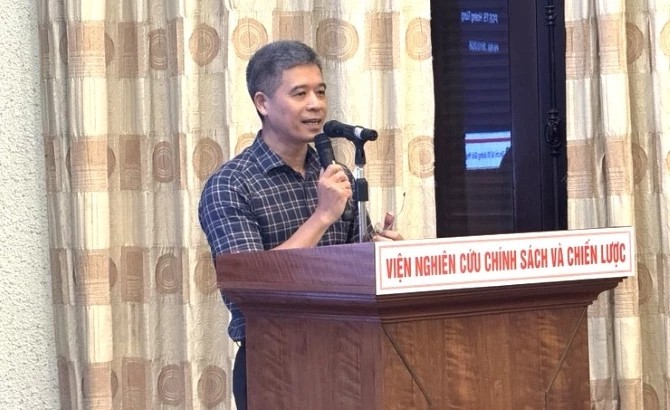
Associate Professor Dr. Hoang Tung, Rector of Hanoi University of Civil Engineering, speaking at the seminar. Photo: HT / Doanh Nghiep Viet Nam. Use the photograph only with the copyright owner's permission.
The article points to Vietnamese companies that have developed strong capabilities in technology and construction. In structural steel, Dai Dung has achieved end-to-end autonomy across design, fabrication and construction for major projects built to international standards. In the digital transformation of the construction sector, Portcoast is cited for investing in 3D surveying equipment and Digital Twin technologies described as among the most advanced in Asia.
With these technologies, Portcoast can survey 82 waterways, covering a total length of 523 km and an area of approximately 5,500 hectares, in nearly one year. The seminar cited that a comparable scope of work could take around five to six years using conventional approaches. The example demonstrates how investment in equipment, technology and an effective surveying workflow can improve delivery times on major infrastructure projects.
Embedding research and technology mastery in major projects
Another issue raised at the seminar was that public investment projects in Vietnam often prioritize construction and equipment procurement, while research, technology adoption and the development of technological capabilities at public universities and research institutes receive less attention. Associate Professor Dr. Hoang Tung argued that every major infrastructure project can provide an opportunity to learn and develop technology, but that opportunity may be lost if research institutions are not involved from the outset.
The article refers to China's high-speed railway development as a coordinated technology acquisition and mastery programme involving six central state-owned enterprises, 25 universities and 11 research institutes. These organizations worked together to study, analyze, test, absorb and improve the imported train technologies. The example highlights the need to enable businesses, universities and research institutes to jointly address technology challenges in Vietnam's major projects.
For education and research institutions, the proposed approach is to assess existing capabilities realistically and begin by understanding technical principles, analyzing designs, carrying out independent calculations and testing existing technologies. Once sufficient knowledge and practical experience have been built, institutions can move towards mastering, improving and developing new technologies instead of pursuing inventions before fully understanding the underlying systems.
Building cooperation among government, businesses and universities
To support this process, the article discusses establishing criteria for measuring technological autonomy and organizing continuous research programmes. Science and technology assignments should be connected so that they produce complete solutions that can be applied in production and daily life. Major public investment projects should also incorporate research and technology-capacity development into their implementation plans.
Cooperation among government, businesses and universities is presented as a foundation for narrowing the gap between research and practical application. The State identifies priority technologies, establishes the policy framework and allocates resources. Businesses invest in technology, apply it in production and provide real operating environments. Universities and research institutes study underlying principles, analyze technologies, build expertise and contribute scientific foundations.
The article also emphasizes that businesses can serve as important practical learning environments for lecturers and researchers, complementing the foundational knowledge taught at universities. Long-term, two-way cooperation can bring research closer to production needs while helping companies strengthen their technological capabilities.
For Portcoast, the example of 3D surveying and Digital Twin technology illustrates how investment can significantly improve productivity and delivery schedules in infrastructure projects. It also provides a basis for stronger cooperation with universities and research institutions, bringing real project experience into education and the development of technology talent.
Source: Hien Thao, Doanh Nghiep Viet Nam, 29 October 2026. This article has been adapted from the original report. Read the original article on Doanh Nghiep Viet Nam.
Source: doanhnghiepvn.vn
Pageviews: …
Cảng vụ Hàng hải TP.HCM đẩy mạnh chuyển đổi số để nâng cao hiệu quả cải cách hành chính
Theo baoxaydung.vn - 29/10/2026
Cũng theo ông Phạm Anh Tuấn, Tổng Giám đốc Portcoast, để tiến tới cảng...
PORTCOAST ỨNG DỤNG CÔNG NGHỆ DIGITAL TWIN THÚC ĐẨY PHÁT TRIỂN CẢNG BIỂN VIỆT NAM
Theo esri.com - 20/10/2026
Ông Trần Phúc Minh Quang, Phó Tổng Giám Đốc Portcoast, chia sẻ cách Di...
KHI “CHẤT XÁM” TƯ VẤN VIỆT NAM ĐI RA THẾ GIỚI
Theo dacsan.thanhnien.vn- 12/10/2026
Nhân ngày doanh nhân Việt Nam 13/10, Đặc san Doanh nhân 2026 của Báo T...